27 Voices, One European Vision:
Youth Leaders Present Climate Adaptation Measures at the EESC
20 March | Brussels
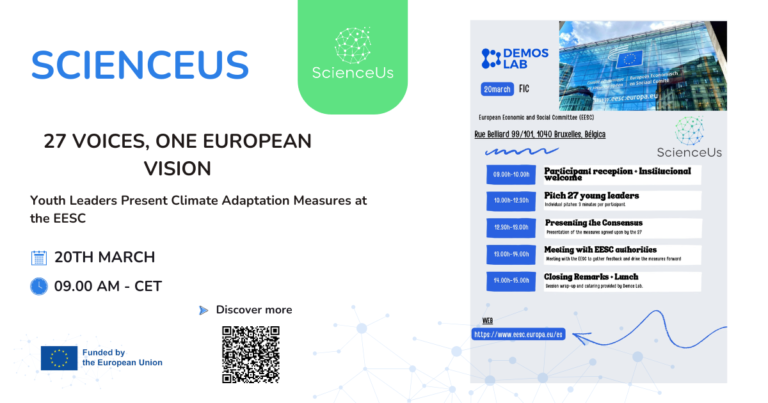
What does a climate-resilient Europe look like when it’s designed by the next generation of leaders?
On 20 March 2026 at 09:00 CET, the European Economic and Social Committee (EESC) in Brussels will host a landmark session of The Future is Climate—a citizen participation and citizen science initiative led by the democracy laboratory Demos Lab, with the support of ScienceUs, the European Climate Foundation, and the Porticus Foundation.
After months of expert input, training, and structured deliberation, 27 young pioneers — one from every EU Member State — will take the floor to present concrete, actionable climate adaptation measures tailored to their national contexts. Beyond the national proposals, they will also deliver something Europe urgently needs: a shared, cross-border consensus on how climate adaptation priorities should be embedded into our collective future.
Why this moment matters
Climate adaptation is often treated as a technical challenge—planning standards, infrastructure upgrades, risk models, funding instruments. But adaptation is also a democratic challenge: it requires legitimacy, trust, public understanding, and the ability to agree on priorities in a complex, high-stakes policy landscape.
The Future is Climate responds to this challenge by combining:
Citizen participation (deliberation, consensus-building, and civic learning), and
Citizen science (structured evidence gathering, community input, and co-creation of knowledge).
In this approach, young participants are not positioned as symbolic voices “for consultation”—but as co-researchers and co-designers of adaptation pathways, equipped to translate lived realities and local insights into policy-ready proposals.
From online deliberation to institutional dialogue in Brussels
The March 2026 gathering in Brussels is a major milestone for the project. Over several days of intensive work hosted by the EESC and the Université Libre de Bruxelles (ULB), participants will consolidate findings from the deliberative process, refine their proposals, and prepare the collective output for policy reception and wider dissemination.
The 20 March session is the public-facing culmination of this work: a moment where youth-led evidence, priorities, and recommendations move from deliberation spaces into direct conversation with European institutions and stakeholders.
What to expect on 20 March
This session is designed as a bridge between youth-led climate adaptation thinking and the institutional ecosystems that can act on it.
Key moments include:
Institutional welcome and opening remarks
A short keynote setting the context: how institutions and civil society actors can enable a climate-resilient Europe through democratic engagement and evidence-informed policy.National adaptation measures (27 proposals)
Each youth representative will present one specific, actionable adaptation measure designed for their country’s needs—practical, implementable, and grounded in the project’s learning process.European consensus and collective priorities
The group will present a unified European perspective: the shared priorities that must underpin adaptation across Member States, and the conditions needed to make them viable.Active listening and policy reception
Institutional and civil society participants will formally receive the set of youth-developed adaptation measures, with space for dialogue and reflection.Networking and next steps
Connecting youth leaders, institutions, researchers, and climate organizations to support uptake, visibility, and longer-term impact.
This event is particularly relevant for:
EU institutions and advisory bodies
National and regional policy actors working on adaptation, resilience, or climate governance
Civil society and climate organizations
Researchers and practitioners working at the interface of science, participation, and policy
Youth networks and democracy innovation communities
Join us in Brussels
Date & time: 20 March 2026, 09:00
Location: European Economic and Social Committee (EESC), Brussels
If your work intersects with climate adaptation, resilience, citizen science, youth engagement, or participatory governance, we warmly invite you to join this pivotal exchange—where Europe’s future adaptation agenda is presented not just about young people, but by them.

“Funded by the European Union. Views and opinions expressed are however those of the author(s) only and do not necessarily reflect those of the European Union or European Research Executive Agency. Neither the European Union nor the granting authority can be held responsible for them.”