Upscale Academy Session – Science for Policy
Session Overview
Date: 30/04/2026
Type: online
Led by: Anastasia Deligkiaouri (& Noémie Maughan – Leticia Martinez Garcia)
Anastacia works as a policy analyst at JRC-European Commission and is in charge of the Learning and Development activities of the Unit. She is developing and delivering courses and trainings for scientists and policymakers at the Science for Policy interface. She is also part of the JRC team in the TSI project on Capacity building in EIPM in 7 EU member states and in which she is developing and delivering the relevant trainings.
Participating CS sub-projects:
– Alleviating Energy Poverty in Vulnerable Households (ENERPOV-CRE)
– Acqua Sorgente
– Coastal Resilience: Action Through Citizen Science (CoRe-ACTS)
– Future is Climate
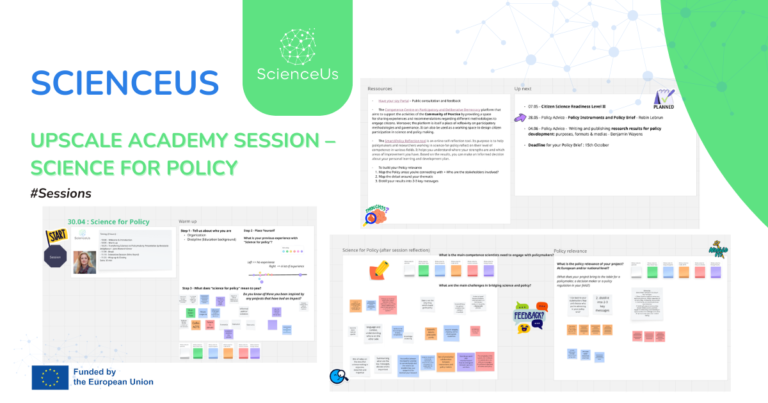
In this session, guided by Anastasia Deligkiaouri from the JRC-European Commission, participants could explore the extended meaning and implications of the Science for Policy concept, Evidence-based and Evidence-informed policy-making. This came as an introductory session for many since only a few of ScienceUs projects and partners has had previous experience with Science for Policy.
Through an interactive presentation and conversation (using a Miro board) participants reflected on the main competence scientists need to engage with policy-makers and on the challenges of bridging science and policy, building up towards the policy relevance of their own project.
Anastasia Deligkiaouri also shared valuable tips on how to engage with policy partners and audience and reach an impact.
Topics of the Session
- What is the JRC (Joint Research Centre), its role, missions and training opportunities it offers?
- What does Science for Policy mean and How does scientific evidence inform policymaking?
- Discover JRC work on citizen participation, (youth) engagement and practical tips in communication, timing, stakeholder understanding.
Highlights & Insights
Science for Policy has gained considerable momentum in recent years, as the complexity of today’s global crises increasingly calls for citizens’ input. Data alone should not guide policy decisions; this is why evidence-based policy has evolved into evidence-informed policy, reflecting the European Commission’s recognition that policymaking must also be a democratic process. In this context, one of the main competences scientists need in order to engage effectively with policymakers is knowledge brokering, along with the ability to understand the language and context of those “on the other side” and to translate complex data into actionable insights. At the same time, one of the key challenges in bridging science and policy lies in summarizing the main messages clearly and deciding what is truly important.
Quotes from Participants
“The idea of Science for Policy is to develop a mindset that the science that we produce can have a real impact”!
Tools, Methods & Resources
- Have your say Portal – Public consultation and feedback
- The Competence Centre on Participatory and Deliberative Democracy platform that aims to support the activities of the Community of Practice by providing a space for sharing experiences and recommendations regarding different methodologies to engage citizens. Moreover, the platform is itself a place of reflexivity on participatory methodologies and governance. It can also be used as a working space to design citizen participation in science and policy making.
- The Smart4Policy Reflection tool is an online self-reflection tool. Its purpose is to help policymakers and researchers working in science-for-policy reflect on their level of competence in various fields. It helps you understand where your strengths are and which areas of improvement you have. Based on the results, you can make an informed decision about your personal learning and development plan.
- To build your Policy relevance
- Map the Policy areas you’re connecting with
- Who are the stakeholders involved?
- Map the debat around your thematic
- Distill your results into 2-3 key messages
- Map the Policy areas you’re connecting with
What’s Next?
This session is part of the series Academy sessions on Policy Advice, helping ScienceUs projects work on their (expected deliverable) Policy assessment and recommendation. Next up will be two sessions with the ULB team respectively on Policy Instruments and Policy Brief (28.05 with Robin Lebrun) and on Writing and publishing research results for policy development: purposes, formats & medias (04.06 with Benjamin Wayens).

“Funded by the European Union. Views and opinions expressed are however those of the author(s) only and do not necessarily reflect those of the European Union or European Research Executive Agency. Neither the European Union nor the granting authority can be held responsible for them.”