Info Day 2 Recap: Citizen Science in Action — Recruiting, Motivating & Sustaining Volunteers
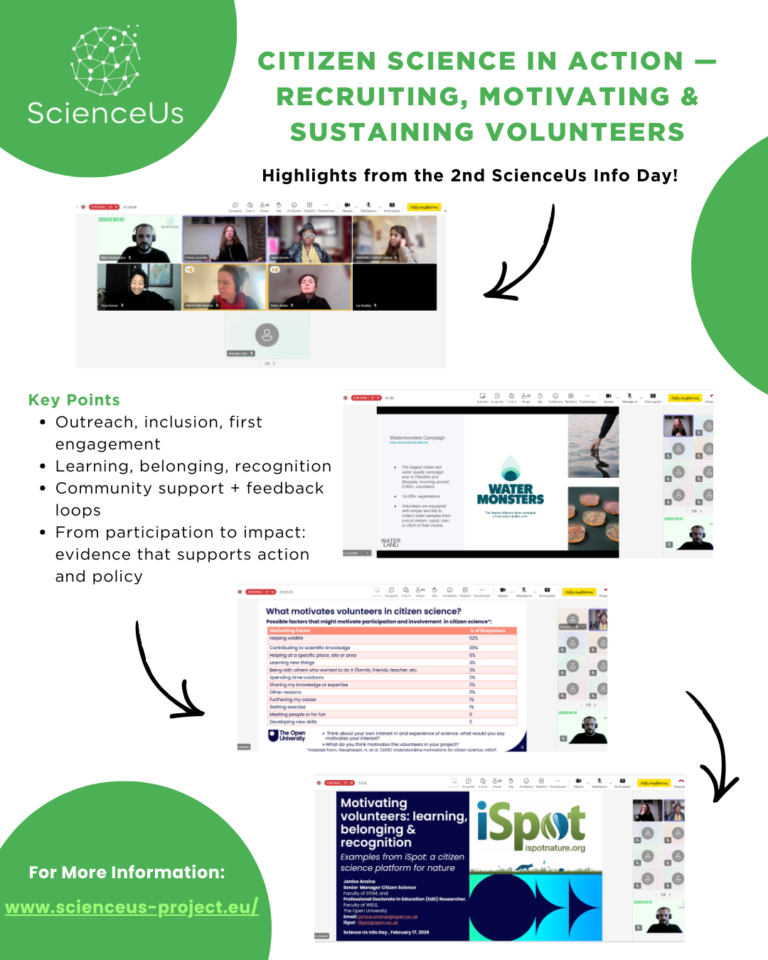
On 17 February 2026, ScienceUs hosted the second session of its online Info Day Series, focused on one of the most decisive success factors in citizen science: people. Under the theme “Citizen Science in Action: Recruiting, Motivating & Sustaining Volunteers in Citizen Science Initiatives”, the session explored how projects can move beyond one-off participation and build long-term, inclusive, high-trust volunteer communities.
From curiosity to commitment: why volunteer engagement is the real engine
The session opened by grounding citizen science in its core purpose: co-creation of knowledge, democratisation of research, and shared responsibility for societal challenges—acting as a bridge between science and society.
A key message: volunteer engagement becomes sustainable when projects intentionally support three human drivers that repeatedly show up in citizen science:
Curiosity (the spark),
Self-efficacy (the feeling “I can contribute meaningfully”),
Community and purpose (the reason people stay).
ScienceUs also connected this “curiosity → commitment” pathway to its own three-phase model (Seed, Flourish, Harvest) and the Upscale Academy, designed to help citizen science initiatives grow from local efforts to transnational impact and policy relevance.
📄 Presentation: Citizen Science in Action: Recruiting, Motivating & Sustaining Volunteers in Citizen Science Initiatives
🔗 Presentation
Recruiting volunteers at scale: Lessons from Watermonsters
Emma Loosveld (WaterLand vzw) shared a practical case study on outreach, inclusion, and first engagement through the Watermonsters Campaign—described as the largest citizen-led water quality campaign in Flanders and Brussels. The campaign drew 14,000+ registrations, even though resources initially planned for 5,000 participants (with participant selection supported by an academic partner to ensure scientific coverage).
What made scaling possible?
Credible partner ecosystem: academic partner KU Leuven, media partner De Standaard, and environmental organisations (e.g., Natuurpunt, BBL, national park actors), plus sponsors.
- Professional communications: a high-visibility public call (“looking for 5,000 citizen scientists”) supported via broad outreach (press, radio, cinema, TV, social media).
- Multiple entry points for different audiences: individuals, schools, and environmental organisations—each supported with tailored materials (e.g., multiple kits, step-by-step guidance, lesson packages).
The case study also highlighted an important “real-world” truth: when engagement works, it can outgrow your operational capacity. One of the strongest takeaways was the need to plan not only for recruitment, but for the logistics of onboarding, support, and follow-through—especially if your goal is diversity beyond the already-engaged.
Results and impact shared in the presentation included findings such as 43% of waterways being clean enough for swimming, while 11.4% were in very poor condition (often linked to small waterways impacted by household wastewater discharge). Beyond data, the campaign tracked public awareness and built routes to policy impact (e.g., recommendations and briefings).
📄 Presentation:Recruiting Volunteers: Outreach, Inclusion & First Engagement
🔗 Presentation
Motivation that lasts: Learning, belonging & recognition
Janice Ansine (The Open University) focused on sustaining engagement through three reinforcing pillars: learning, belonging, and recognition, using iSpot (a nature-focused citizen science platform launched in 2009) as a long-running example.
A standout illustration was the “Katie and the moth” story: a child’s observation posted on iSpot was identified by the community within 24 hours as a species not previously recorded in the UK—demonstrating how participation can create real scientific value and a powerful personal experience of contribution.
Janice unpacked the mechanics of motivation in practice:
- Learning: iSpot lowers barriers to identification and builds skills through community-supported feedback and expert input.
- Belonging: participation tools (comments, agreements, IDs, quizzes, projects) create social connection and sustained interaction—turning “users” into a community.
- Recognition: reputation and participation rewards support continued contributions, alongside links to formal and informal learning pathways.
The scale shared was significant: 84,000+ registered users, 890,000+ observations, 1.8 million images, from 180 countries, and millions of community interactions (e.g., agreements).
📄 Presentation: Motivating volunteers: learning, belonging & recognition
🔗 Presentation
What we take forward: practical principles for stronger volunteer communities
Across the session, several actionable principles emerged:
Design engagement, not just data collection. Citizen science succeeds when volunteer experience is treated as core project infrastructure.
- Recruitment scales through trust + partnerships. Strong, credible partners (research, media, NGOs) expand reach and legitimacy.
- Inclusion requires tailored support. Different audiences need different onboarding materials, formats, and guidance.
- Retention happens when people feel progress. Volunteers stay when they learn, feel they belong, and receive recognition—and when they can see outcomes (including policy influence).
- Community maintenance must be planned. Newsletters, helpdesks, lectures, and continued interaction keep momentum alive after the “campaign moment.”
What’s next in the Info Day Series
The next session (Info Day 3 — 27 March 2026) will focus on Citizen Science for Climate Justice and Policy Influence, exploring how citizen-generated evidence and lived experience can support fairer climate decisions and amplify underrepresented voices.
ScienceUs continues to build a pan-European citizen science ecosystem that strengthens climate resilience, supports policy impact, and accelerates citizen-driven innovation—connecting universities, research organisations, civil society, local communities, educators, and public authorities.

“Funded by the European Union. Views and opinions expressed are however those of the author(s) only and do not necessarily reflect those of the European Union or European Research Executive Agency. Neither the European Union nor the granting authority can be held responsible for them.”